
Take the Trail
Start at the corner of West Terrace and Wylde Road.
This Trail is on the traditional land of the Kaurna people.
Last updated: March 2026

Optional: download and print a tri-fold leaflet, i.e. a double-sided single A4 page, with a brief summary of this Trail Guide: (PDF, 1.95 Mb)

1. Introduction and Naming
This Park is called G.S. Kingston Park, also known as Wirrarninthi or simply Park 23.
Park 23 is 57 hectares. It's bounded by Anzac Highway to the south, West Terrace to the east, Sir Donald Bradman Drive to the north and the Railway lines to the west. The park is broken into three sections; the northern and southern portions being split by the West Terrace Cemetery.
It's named after Sir George Strickland Kingston, who was appointed as the Deputy Surveyor to Colonel Light in 1837 as Adelaide was laid out. Kingston was an engineer, architect and surveyor who was responsible for the design of several significant Adelaide buildings and the first monument to Colonel Light. Later, he became the first Speaker in South Australia’s House of Assembly.
He was an establishment figure, walking city streets with a silver-topped cane. Kingston lived in nearby Grote Street.

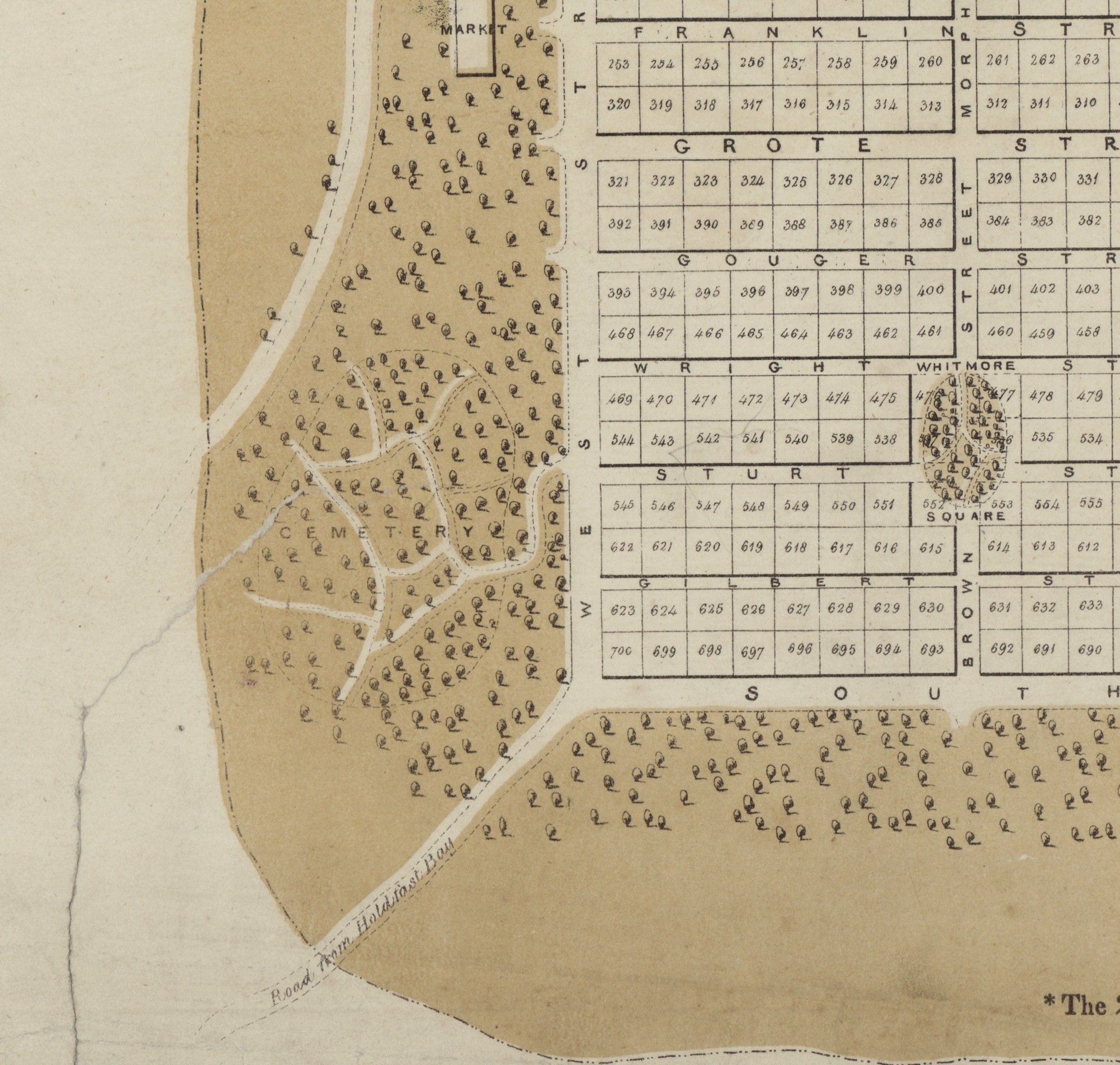
A 1936 aerial photo (left), and Colonel William Light’s 1837 plan for the south-western Park Lands (right)
In 2002 this Park 23 was named “Wirranendi” - pronounced “Wirrarninthi” which would become the new spelling of the Park’s Kaurna name in 2013. The name means to ‘become transformed into a green, forested area’. The Park has been transformed over decades, as you'll see on this Trail.
Park 23 is so large that this Trail Guide is confined to the northern section of the Park. We’ll also touch on the northern fence-line of the West Terrace Cemetery. This Trail Guide does not include the southern portion of Park 23, alongside Anzac Highway (known as “Edwards Park”) but that is included in a different Trail Guide:
From here, walk across Wylde Road and stop behind the playground, to view both the playground and the sporting fields off Wylde Road.

2. Playspace and sports oval
.
Playground:
This children’s playground opened in 1924.
At the opening, the Governor, Attorney-General and the Lord Mayor were welcomed by a guard of honour of children from local schools. A pipe and drum band played, while the children sang the national anthem and performed a dance.
It’s undergone many renewals since its creation and now contains a climbing web with slide attached, junior fort, spring rides, double swing and bucket swing.
When it opened, the playground was surrounded by fencing to keep out grazing livestock. It was also divided by age and gender.
By 1928 the playground had a full-time supervisor paid by the Education Department. The supervisor had a direct telephone line to the police. The playground was hosting more than a hundred children every day – some days over 200.
A City Council document, published in November 2024, says that this playground was frequented by Aboriginal children living in the West End of Adelaide during the 1930s to 1950s.
There are six particularly large specimens of Aleppo Pine (Pinus halepensis) trees located adjacent to and within the West Terrace Playground.
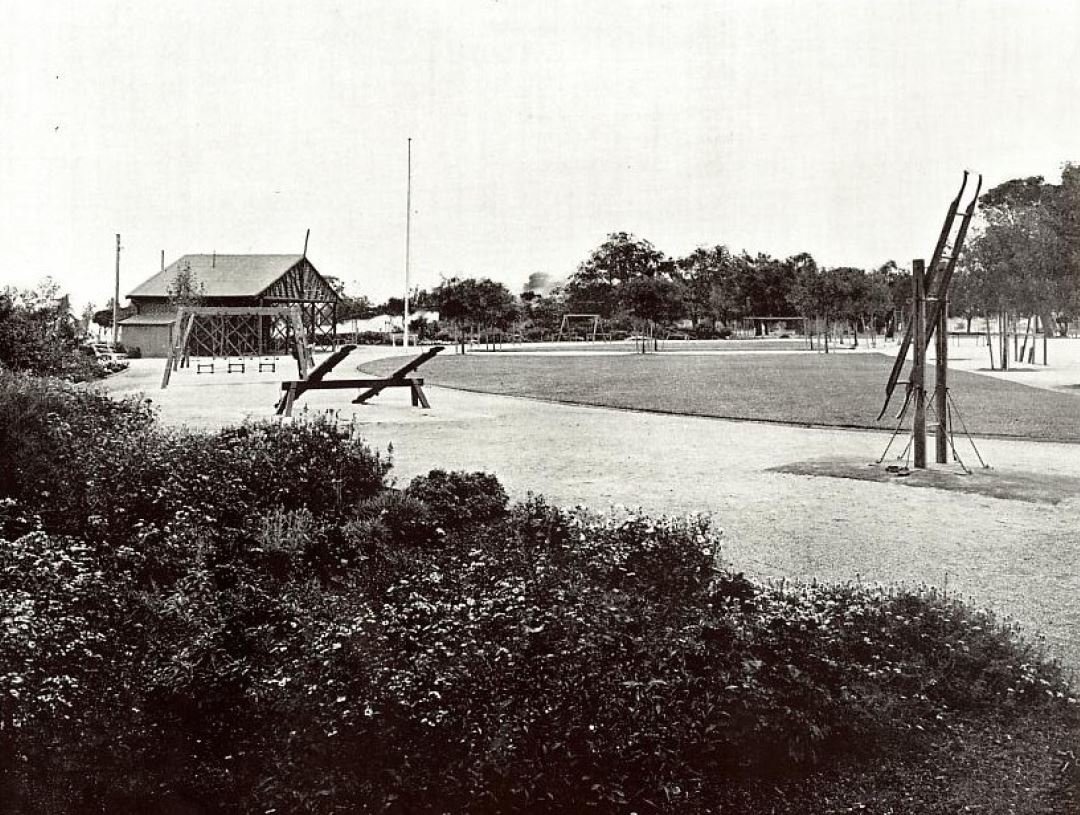
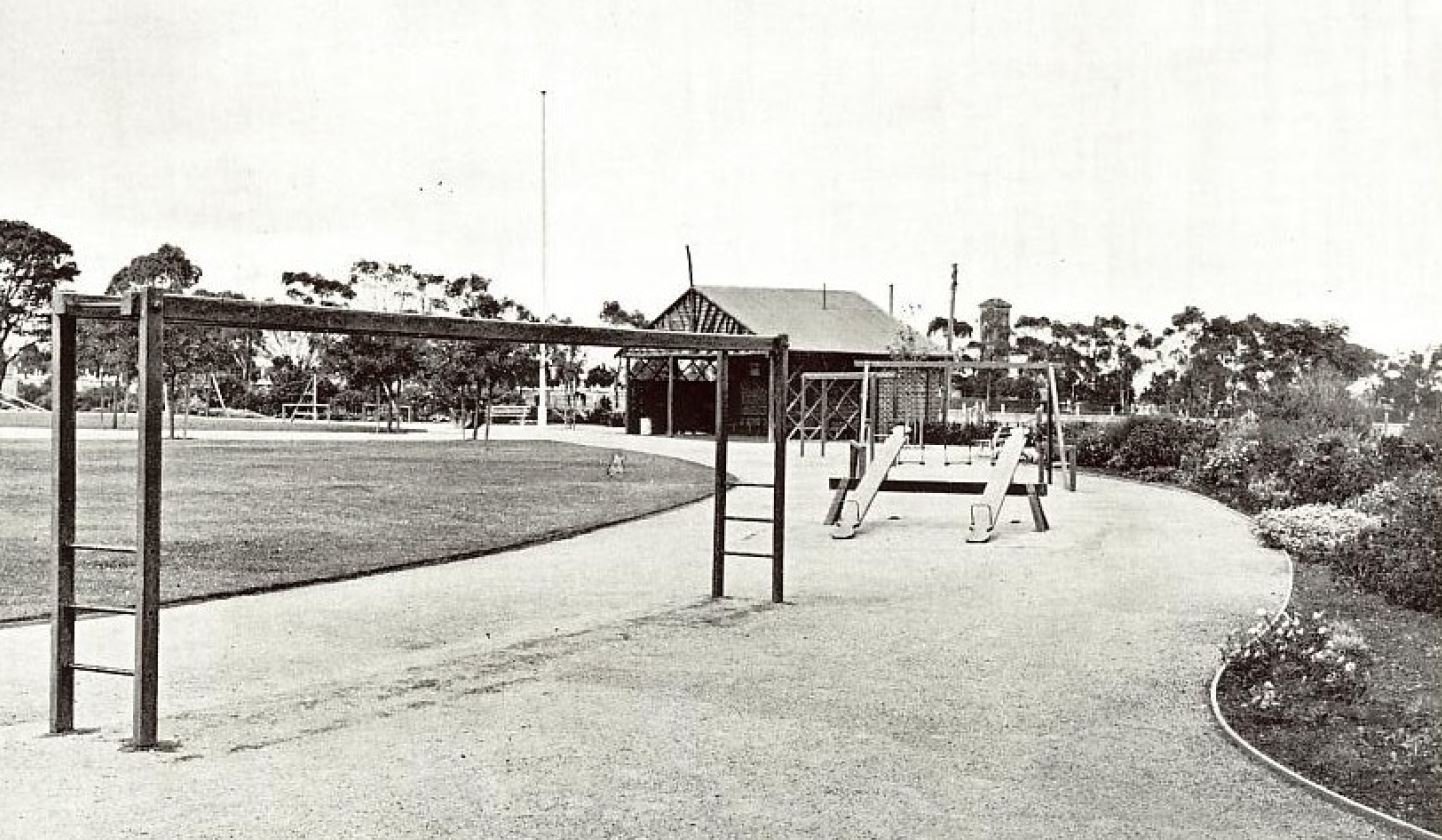
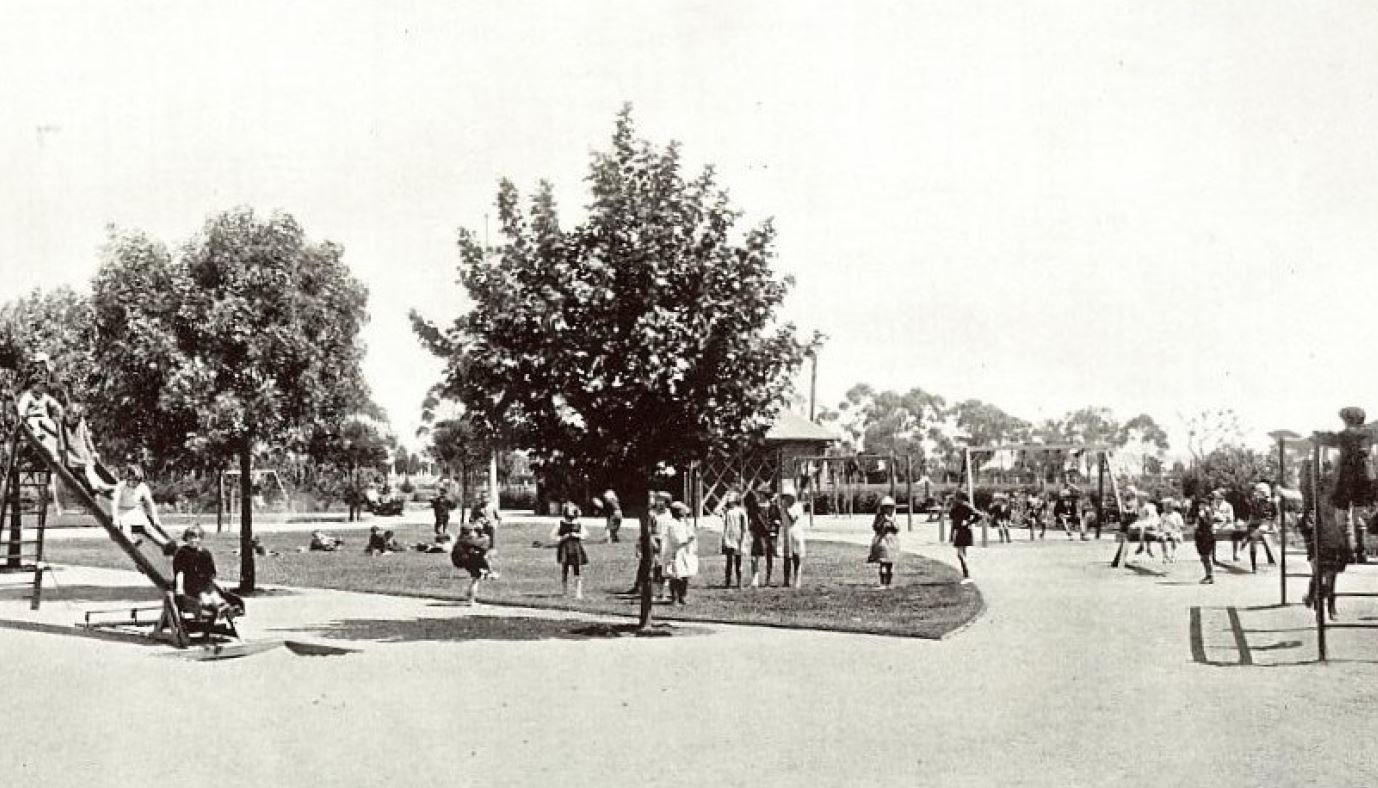
The West Terrace playground photographed in 1928. Images: City of Adelaide Archives
At that stage, the playground was surrounded by fencing to keep out grazing livestock. It was also divided by age and gender.
By 1928 the playground had a full-time supervisor paid by the Education Department. The supervisor had a direct telephone line to the police. They playground was hosting more than a hundred children every day – some days over 200.
A City Council document published in November 2024, says that this playground was frequented by Aboriginal children living in the West End of Adelaide during the 1930s to 1950s.
There are six particularly large specimens of Aleppo Pine (Pinus halepensis) trees located adjacent to and within the West Terrace Playground.
Sports:
Park 23 has a long association with sporting activities. The painted brick building between the playground and the sporting field was built in the 1960s and includes both clubrooms and toilet facilities.
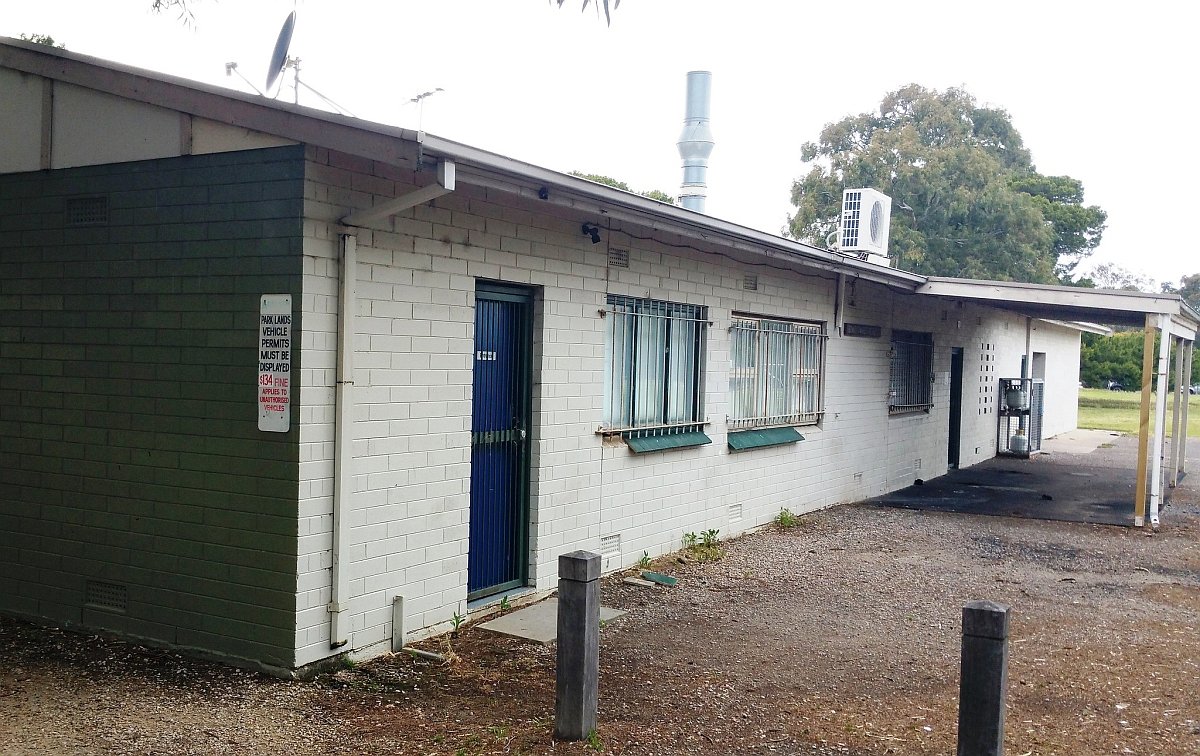
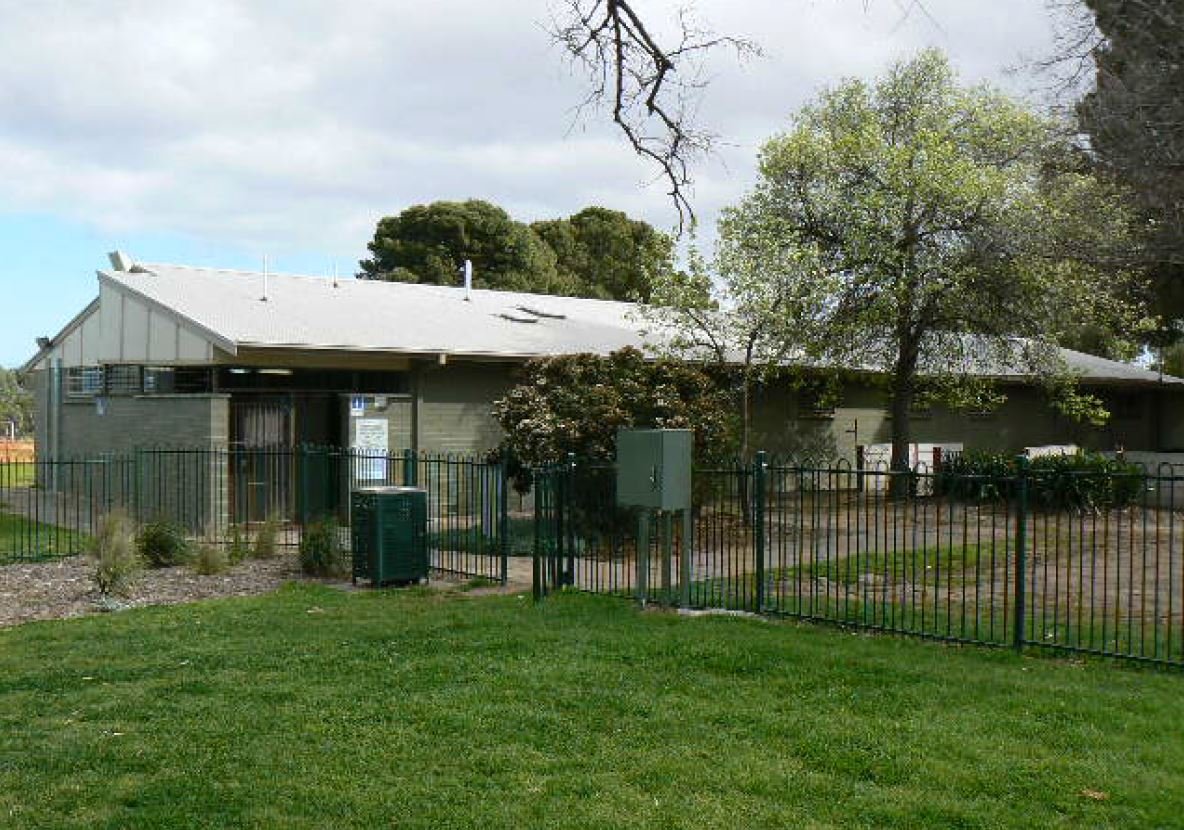
The playground toilet block and clubrooms as it looked in 2017 (left) and in 2007 (right).
Behind this building is an oval that was constructed in 1936. It was named Bone Timber Reserve after the council’s Director of Parks and Gardens, Mr Bone. Today this oval and clubrooms hosts the Adelaide Cricket Club.
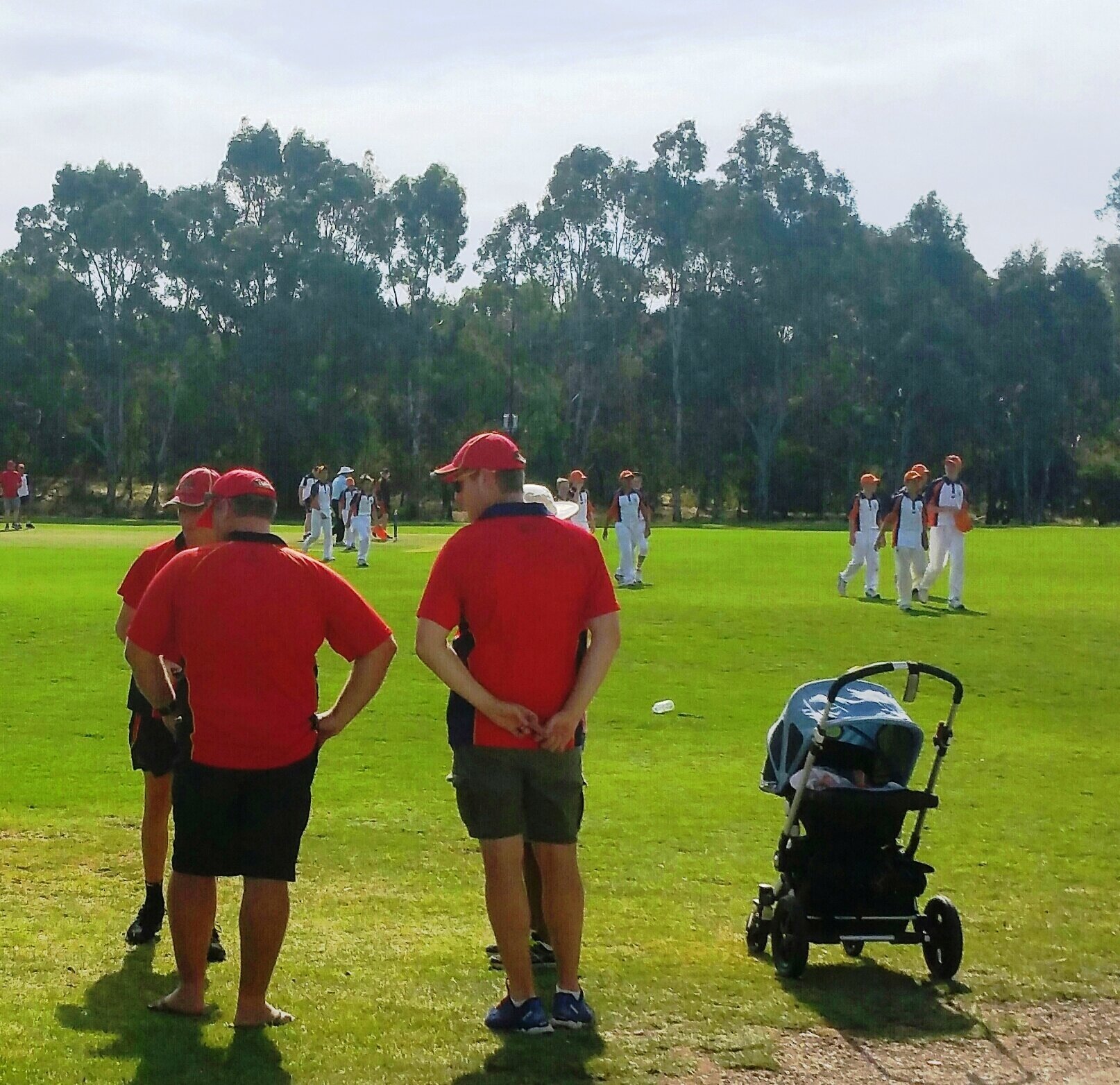
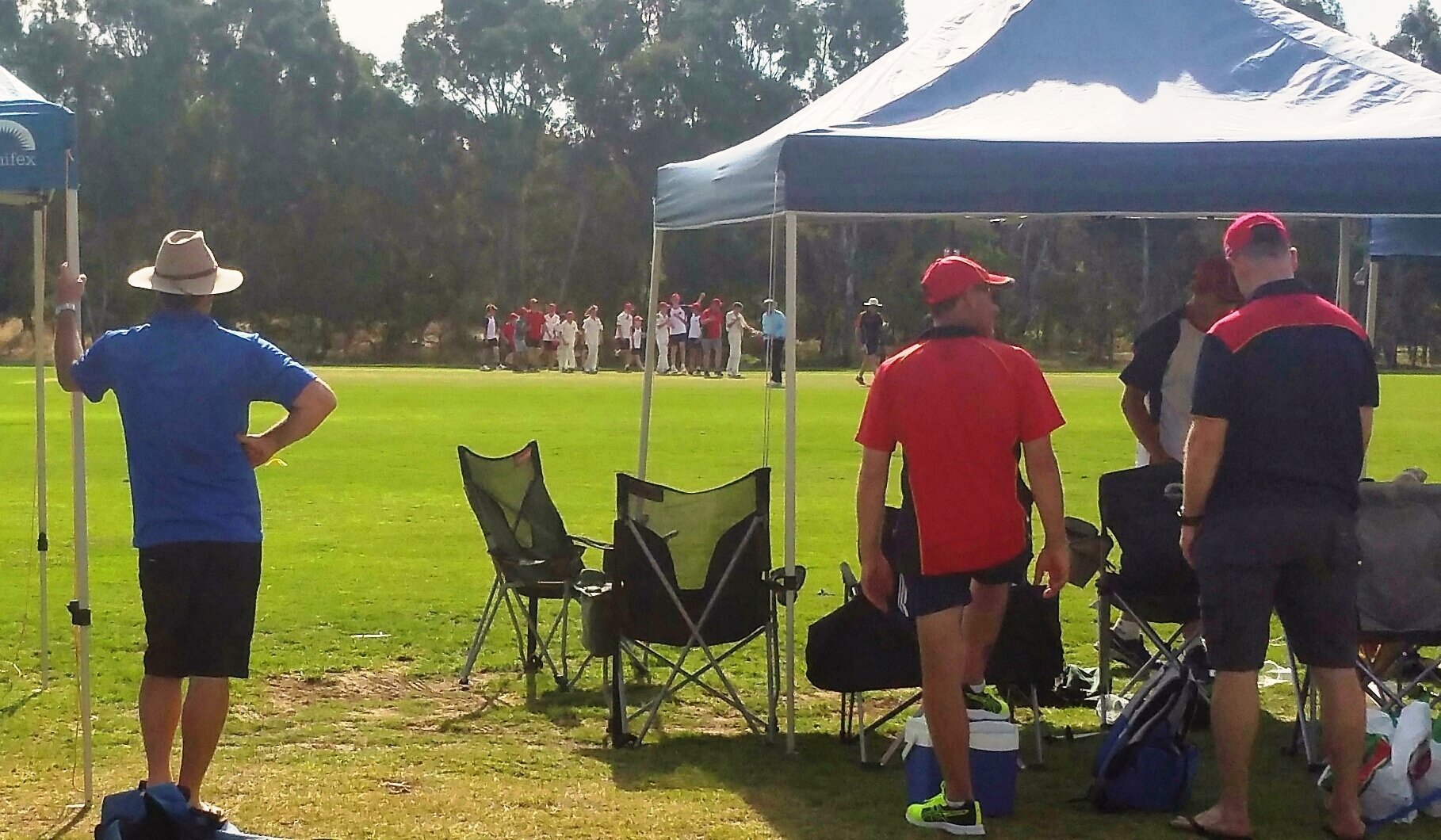
Sporting activity here hasn’t been without controversy. From the 1920s, some Protestant church groups pressured the council to ban the playing of sport on the Sabbath so in 1939, the Council passed a regulation effectively banning organised sport in all of the Park Lands on a Sunday. The ban continued until the Dustan Government removed it in 1967.
From here, walk a little further north to Kingston Gardens and the bandstand/rotunda.

3. Kingston Gardens
Kingston Gardens is the epicentre of this 57 hectare park. In the first decade of the 20th century, the development of Park 23 began right here, on a 1.2 hectare site at the intersection corner. When you consider that the Adelaide Park Lands were a World First, just image what it must have been like to to be able to picnic and relax in such a place while still being close to the heart of the city!
In 2017 the City Council decided to extend the name G.S. Kingston to cover not just these gardens, but also the whole of Park 23.
The centrepiece of Kingston Gardens is the rotunda. It was opened in 1909. The area was also fenced off and planted with trees, shrubs and flowers, and electricity connected for lighting the bandstand. At the time, in 1909, The Advertiser reported that 3,000 West Adelaide residents attended the opening of the gardens.
In 1912 Kingston Gardens bandstand became a venue for Wattle Day celebrations managed by the Kindergarten Union of South Australia. The bandstand was used regularly for concerts and events from the 1920s until the 1940s but since then it has served largely as an ornamental structure. It was restored only last year. Some of you may recall seeing it fenced off.
Wattle Day was established in 1910 to foster a unified Australian national identity following Federation with a push to establish the wattle as a symbol of Australian identity rather than just British. People would wear a wattle sprig, and schools would engage in tree-planting. Later it became a patriotic, charitable, and fundraising event for the Red Cross and other charities during World War I.
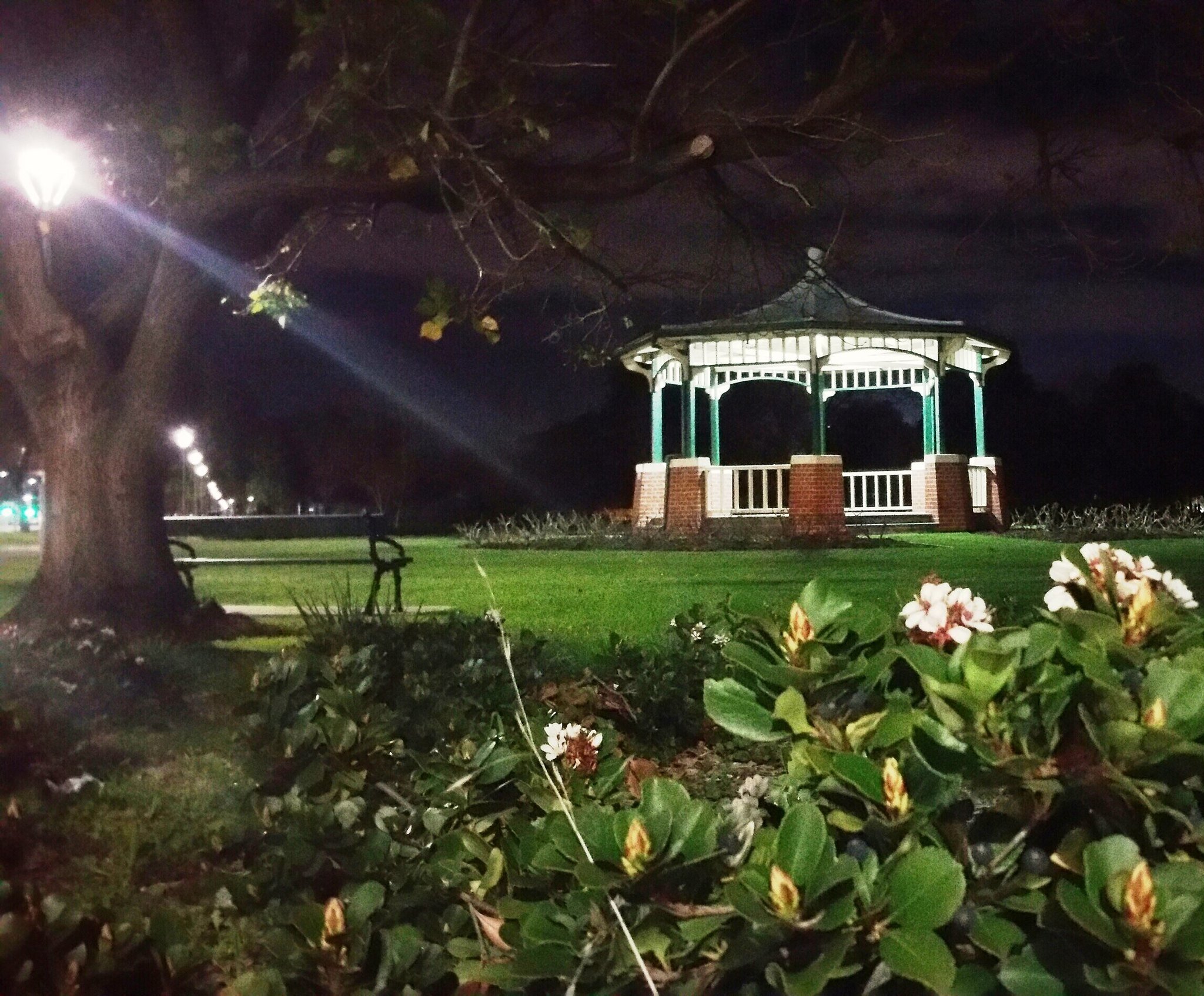
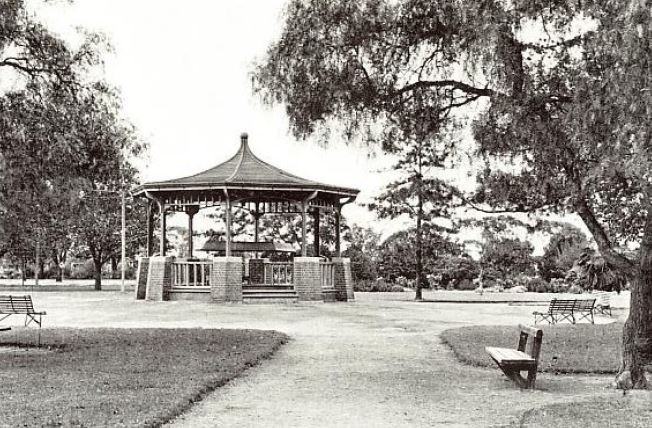
The Kingston Gardens rotunda at night (left) and as it looked in 1928 (right, from City of Adelaide archives).
According to academic David Jones (2007) some of the significant trees in Kingston Gardens included (at the time he was writing):
a Hoop Pine (Araucaria cunninghamii) probably planted in the 1960s
a Date Palm (Phoenix dactylifera) over by the street corner;
a Pepper Tree (Schinus aeria var molle) along the edge of West Tce in the Kingston Gardens precinct that pre-dates the development of Kingston Gardens;
an arc of eight American Hackberry (Celtis occidentalis) planted by Pelzer during the very early 1900s when the garden and adjacent playground were established.
You’ll also see two Norfolk Island Hybiscus either side of the picnic table – their buds open to a beautiful pink flower.
From this point, take the path towards Sir Donald Bradman Drive and turn first left onto the dirt trail before you reach the end. Follow the path of reeds on your left which veer left away from the path. Leave the path and follow the reeds until you reach a wooden bridge. Stay on this side of the creek. Walk past the bridge to the big stone sculpture a few metres past it.

4. Water and duck sculptures

Look for this this water sculpture just past the bridge.
These wetlands include native plants, which attract native birds and animals.
They filter stormwater and runoff from the city’s air-conditioning systems.
This water sculpture depicts a variety of aquatic plant and animal species that are often difficult to observe from land.
You are currently in the Water Zone of the Wirraninthi Environmental Education Trail, which you’ll find out more about later in this trail guide. The Environmental Trail is divided into 4 sections – Water, Earth, Fire and Wind and you’ll be passing through each of these sections on this walk.

From the water sculpture, continue in the same direction for another 20 metres. The path will end at with bush and trees. Behind this is a sculpture of Australian Wood Ducks. Depending how much rain there has been recently, you may be able to walk around the scrubs to see the the wood duck sculpture, but if there’s been recent rain, the sunken ground may be flooded or muddy.
This is a sculpture of Australian wood ducks, also known as the “maned duck.” They are very common in your Adelaide Park Lands.
The artist is Silvio Apponyi who not only created a lot of the sculptures on this walk, but coordinated the overall artistic contribution to this park.
Wood ducks provide an example of how complex interactions in the environment can be. Wood ducks can help transport other animals and plants between habitats.
Sometimes plants and seeds eaten by the ducks survive undigested to grow wherever the birds travel.

Eggs of water insects and fish may also stick to a duck’s feet or feathers and be carried to new habitats where they can grow and become part of the ecosystem.
Therefore, as ducks travel in search of food, they can bring greater biodiversity with them.

The duck sculpture might be hard to spot, hidden behind trees, on ground that might be flooded or muddy if you are visiting after recent rain.
Therefore, as ducks travel in search of food, they can bring greater biodiversity with them.
From the duck sculpture, retrace your steps along the dirt path, past the wooden footbridge and keep going until you return to the wider dirt path at the end. Turn left, almost a U-turn. You’ll find a low rock sculpture near the corner of the dirt paths with a fading snake sculpture cut into it (pictured below). There are 11 of these Discovery Rocks to be found in the Earth Zone.

5. Earth discovery area
The Wirrarninthi Environmental Education Trail includes most of what the City Council describes as one of the few “Key Biodiversity Areas” in your Adelaide Park Lands. Another can be found in Park 6 Lefevre Park in North Adelaide.

A City Council 2024 biodiversity report identifies all of this area between the West Terrace Cemetery, and Sir Donald Bradman Drive as one of the few ‘Key Biodiversity Areas’ in your Adelaide Park Lands.
A Park Lands Management Strategy “Towards 2036” which was endorsed by the City Council in November 2024 includes, as a Target: “Improve the revegetation and habitat qualities of [this Park] to support its classification as a Key Biodiversity Area.”
You have now left the “Water zone” of the Environmental Trail and are standing in the “Earth zone”.
This Mallee Box woodland in the “Earth zone” resembles what the Adelaide Plains would have looked like before the city was founded.
Plants provide the start for most food chains such as the many types of wattle trees in the area that provide food and shelter for people and animals. In the past, the Kaurna people ground wattle seeds into flour for food.
There are 10 more Discovery Rocks in the Earth zone.

Some of the 10 discovery rocks in the Earth zone.
You’ll notice some rocks with a coloured dot on them. The colour tells you what zone we’re in. The Earth zone, for example, is green. Wind is blue. Fire is red, etc
Follow the dirt road west, parallel to Sir Donald Bradman Drive. Just before you reach the sealed Catholic Cemetery Road, turn left and walk over the grassy area to the possum sculpture, which sits on its own on

6. Possum sculpture
This sculpture is also by Silvio Apponyi, made in 2010. He has a very similar possum sculpture in Possum Park / Pirltawardli (Park 1).
Possums are one type of Australian mammal that has adapted well to living in urban environments. They are commonly seen in parks and neighbourhoods throughout Adelaide.
Hundreds of possums are scattered about your Adelaide Park Lands, but they’re spread out very unevenly. Some parts of your Park Lands have few, or no possums, but the greatest concentration is in Whitmore Square!
The Adelaide Park Lands are home to both the Brushtail Possum and the Ringtail Possum.

The native bee hotel, immediately north of the cat sculpture.
Immediately to the west of the possum sculpture (on the other side of the road) you can see a native bee nesting house.
This native bee nesting house was built by community volunteers as part of the River Torrens Recovery Project. Native bee “hotels” and native food plants can be found at a number of locations along the River Torrens to provide bees with more places to live and forage.
You can use the sign, next to the bee nesting house to try to identify any bees you might see nesting here.
Walking a short distance up Catholic Cemetery Road towards Sir Donald Bradman Drive, to the Poem Rock, in between two bench seats.

7. Poem rock
Carved into this rock rock is a poem, “Wirranendi” by Kimberly Mann (pronounced Wirrarninthi).
Wirrandendi was the former spelling of this Park’s Kaurna name. It was changed in 2013 to “Wirrarninthi”.
In case you can’t read it directly from the rock, the poem is:

Walk the Wirranendi Trail
look up into silhouettes of branches
where magpies sing tidings
across the dry plain
Travel between rocks
witness the abyss
follow your self in
close your eyes
still your mind for a while
moon floats high in a white sky
swallow memory and learn
The wind chases spirits through here
-- Kimberley Mann
Continue walking up to Sir Donald Bradman Drive. To your right are the stone domes called “Lie of the Land”.

8. Lie of the Land
The 14 stone domes are one-half of a public art installation, called “Lie of the Land”.
The domes are on both sides of Sir Donald Bradman Drive - in both Park 23 and in Park 24. On the opposite side of the road, the domes are located a bit further east, towards the city.
The domes are made of Kanmantoo stone. They were inspired by a drawing of winter encampments of indigenous Australians camped near Adelaide at the time of European settlement. The drawing can be found in the SA Art Gallery and was done in 1858 by Eugene von Guerard.

Drawing (1858) by Eugene von Guerard: “Winter encampments in wurlies of divisions of the tribes from Lake Bonney and Lake Victoria in the parkland near Adelaide”
Prior to European settlement Kaurna people hunted and gathered food, medicinal plants and material for their shelters in this area.
There was a design competition in 2001 to create a “Gateway Statement” for people arriving in Adelaide, from the airport. This proposal, the “Lie of the Land” was the winning entry by artists Jude Walton and Aleks Danko.
The official opening was by former State Government Minister John Hill in 2004. You can read more about these sculptures here: https://www.adelaide-parklands.asn.au/blog/2023/6/25/know-your-park-lands-art-lie-of-the-land
There is also an information board just in from where you’re standing if you’d like more information.

Wirrarninthi Environmental Education Trial trifold brochure
Before moving on, the Adelaide City Council provides a free Wirrarninthi Environmental Education Trial trifold brochure, found in the brochure holder at the very start of the Cemetery road coming in off Sir Donald Bradman Drive entrance (beside the stone dome artwork). Feel free to take one.
Backtrack along the Cemetery road a few metres to the start of the Wirrarninthi Environmental Education Trail stone sign.

9. Environmental trail (entry)
Having been through the Water and Earth zones of the Wirrarninthi Environmental Education Trial, you are now at the actual start of the Trail.
This trail is perhaps the best-kept secret of your Adelaide Park Lands.
The Wirrarninthi Environmental Education Trail is a 2.1-kilometre loop. It does not include any part of the West Terrace Cemetery.

The overarching theme of this environmental trail is how our own actions can affect the environment – not just where we live, but also a long distance away from us.
Sculptures and other public artworks reflect the theme of each area as you’ve seen. Smaller stones sometimes have images which school aged children can use to create rubbings. It is a valuable area for biodiversity, with wood ducks, parrots of all colours and a variety of indigenous plants.

Rock sculpture of an albatross chick
This rock sculpture by the entrance sign is of an albatross chick that died after being fed bits of floating rubbish that its parents had apparently mistaken for fish.
Albatrosses spend most of their lives far out at sea. They feed on fish and raise their young on islands far from where many people live. Silvio Apponyi created this work too and as you’ve probably already ascertained, he’s famous for his native animal sculptures.
Silvio was engaged to both create a a lot of the artwork along the Trail, and to coordinate even more by engaging several artists. These include John Wilson for pieces found in the NE quadrant of the environmental trail, indigenous artist Shereen Rankine for the fire quadrant in the NW corner of the trial, Sally Wickes for the wind quadrant in the SW, and of course, poet Kimberly Mann for the poem rock which you’ve already seen.
From the entry point, walk westwards following the dirt trail towards the railway line, then turn left and the end and follow the dirt trail several metres southwards alongside the railway line.

Participants in an APA Guided Walk in 2021, heading westwards towards the Fire Sculpture

10. Fire sculpture
A short distance south from Sir Donald Bradman Drive, you'll see a series of carefully arranged stones known as the Fire Sculpture. Beware of bull ants as you stop to admire this artwork!
This sculpture depicts marks that animals and humans have left in Wirrarninthi over time, especially those things that may have remained after periodic fires.
The markings on the sculpture show the footprints of animals that may have passed through the area since before European settlement until now. The bones and rubbish around the circular base show how changes in culture and technology have changed the marks people leave on the land.

Stopping at the fire sculpture during an APA Guided Walk in 2021.
It reminds us of the impacts of European settlement since 1837. In the 1860's, this park was fenced in white-painted timber post and wire. By that time (the 1860s) most of the native vegetation had been effectively removed.
In the 20th century, before the Wirrarninthi Environmental Education Trail was established, you might once have come across gum trees, open space, campsites, a quarry, horse, cattle or sheep grazing, or even a rubbish tip.

The wetland you will see to your left as you walk south between the fire sculpture and the wind sculpture. A City Council 2024 biodiversity report notes that the waterhole has few fringing reeds and rushes due to trees and shrubs shading the edge, but there are native sedge and rush species.
Keep walking south alongside the railway line until you come to another stone sculpture.
As you following the trail south, you will see the railway lines on your right and (unless recent weather has been very dry) you’ll see a wetland area to your left.

11. Wind sculptures
The two adjacent rock sculptures are intended to be evocative of wind. But how do you make wind into rock art?
You can see an ear in the larger of the two rocks, reminding us of the sound of wind.
If you look carefully at the smaller of the two sculptures you might discern a plastic bag depicted on the rock. This is a reminder that what we throw away sometimes gets carried by the wind and can do harm to animals or birds who might eat it or get trapped by our rubbish.

The larger of the two wind sculptures next to the railway lines.
From here, take the dirt path between the two sculptures. It goes quite a distance, skirting the wetland and creek bed to meet up again with Catholic Cemetery Road. If you’re not comfortable to do that, walk another metre or two past the wind sculptures and take the more open path along the side of the cemetery. Both paths rejoin at the end of cemetery road.

Domestic cat with bird: sculpture by Wilson on the Wirrarninthi environmental trail
12. Cat Sculpture
At this point you are at the intersection of the Wirrarninthi Environmental Education Trail and Catholic Cemetery Road.
There is a distinctive bronze statue of a cat that has caught a bird and (a nearby) lizard; a comment on the problem of pet cats hunting native animals in Australia.
This sculpture is one that is often credited to Silvio Apponyi however, it was only inspired by him. The artist is John Wilson who made it in 2010.
Cats are such common animals that we forget there were no cats in Australia before European settlement. Cats may be cute and cuddly, but they are also highly effective predators and have contributed to the decline of small animals around the world.
Turn around and walk to the entrance to West Terrace Cemetery.

13. Cemetery entrance
This is the northern entry to the Catholic Section of the West Terrace Cemetery. The cemetery is an integral part of Park 23 and remains Australia’s oldest still-operating metropolitan cemetery. It was included in Colonel Light’s original 1837 plan for Adelaide.
Over the years - as growth and demand has occurred - portions of Park 23 have been added to the size of the Cemetery. It initially comprised an area of 13 hectares. The total area today is more than double that - 27 hectares. That means that the cemetery occupies just under half of Park 23. That is, 27 hectares out of the Park’s 57 hectares.
West Terrace cemetery is divided into a number of sections for various communities and faiths, including two Catholic areas, as well as Jewish, Afghan, Islamic and Quaker sections. The first burial took place in July 1837 and there are more than 150,000 internments.

It is often described as the most significant cemetery in the State because it contains the remains of many of the citizens who helped shape the origins of South Australia. It is also officially classed as one of the dozen most significant burial grounds in Australia.
Many Indigenous people have been buried in the cemetery and there's a sad history of grave-robbing of several Aboriginal bodies. The biggest scandal occurred in 1903 when State Coroner Dr William Ramsay Smith was publicly accused of grave-robbing. In fact, as the coroner, he was found to have been stealing the bodies of indigenous people, dissected them, and sending their parts to the University of Edinburgh in Scotland for research. In their place, he buried coffins filled with sandbags so no-one would know.
The most notable of these victims was Ngarrindjeri identity Tommy Walker who was a popular and spirited character around town – so much so that when he died in 1901, the local stock exchange paid for a proper funeral and headstone for him here in the West Terrace Cemetery. It wasn’t until 2003 that his remains were returned from the University of Edinburgh, allowing his relatives to finally buried him, 102 years after his death.
From here, walk into the Catholic section, and turn left at the path junction. Stop at the small octagonal stone chapel.

13. Smyth Chapel
This Roman Catholic “Smyth Chapel” (pronounced “Sm-eye-th”) was erected in 1870 and is on the State Heritage Register. It is a memorial to the Very Reverend John Smyth. A building of this form and style is rare in Australia.
It is a graceful, octagonal, early gothic revival chapel with pointed roof terminating in a fleche. The walls are bluestone with slate floors and steps, and sandstone “grotesques”; the roof covering is of corrugated iron.
A gargoyle contains a waterspout through the mouth, whereas grotesques do not. An easy way to remember is to think of the word “gargle” which involves water in your mouth.

1870 Smyth chapel
From this point, walk east towards the gates on Wylde Road, then turn right into the cemetery and then left through the graves until you come to a wire fence with the crematorium ruins inside.

14. Crematorium ruins
Adelaide can lay claim to many things, but perhaps one of the least known claims is that of being the home of the first crematorium ever built in the southern hemisphere.
The crematorium was built here in 1903. These days cremation is very common but back then South Australia was the first State in Australia to legalise the procedure.
The crematorium had an underground furnace room, a single cremation chamber and a chimney that was designed to look like an Italian bell-tower.

The crematorium in 1919.
In the early days it was difficult to heat the furnace sufficiently hot to disintegrate the entire body and bones. They used gas coke (a fuel with a high carbon content but little pollution from burning) and mallee firewood.
The Crematorium used dead animals, such as sheep, to practice upon to make sure they got their temperature high enough, and their procedures right. The first human cremation attracted a crowd of about 200.
In its early days the crematorium saw barely any use, but soon it became popular, and before its closing in 1959, after 56 years of operation, it had been used to cremate the remains of 4,762 people.
The building was demolished in 1969. In recent times, archaeologists have tried to uncover the foundations of the building. They found the furnace intact underground, along with bricks, and scraps of metal and a damper for the chimney.

Visiting the crematorium ruins on an APA Guided Walk
Other West Terrace Cemetery highlights:
For those of you with a “burning” desire to find out more secrets buried in the West Terrace Cemetery, they run their own tours which are well worth checking out. Some of the highlights of the West Terrace Cemetery include:
Memorials to many famous South Australian and other historical figures, including Carl Linger who wrote the Song of Australia
Native apricot and quandong groves tucked away amongst the graves
The Australian Imperial Force (AIF) Cemetery - Australia’s very first dedicated military cemetery, opened in 1920 which includes a 10m tall Cross of Sacrifice.
From here, return to the road you were on previously. The gate leads out onto Wylde Road where you started your tour.
Optional: download and print a tri-fold leaflet, i.e. a double-sided single A4 page, with a brief summary of this Trail Guide: (PDF, 1.95 Mb)
All of our Trail Guides and Guided Walks are on the traditional lands of the Kaurna people. The Adelaide Park Lands Association acknowledges and pays respect to the past, present and future traditional custodians and elders of these lands.

