
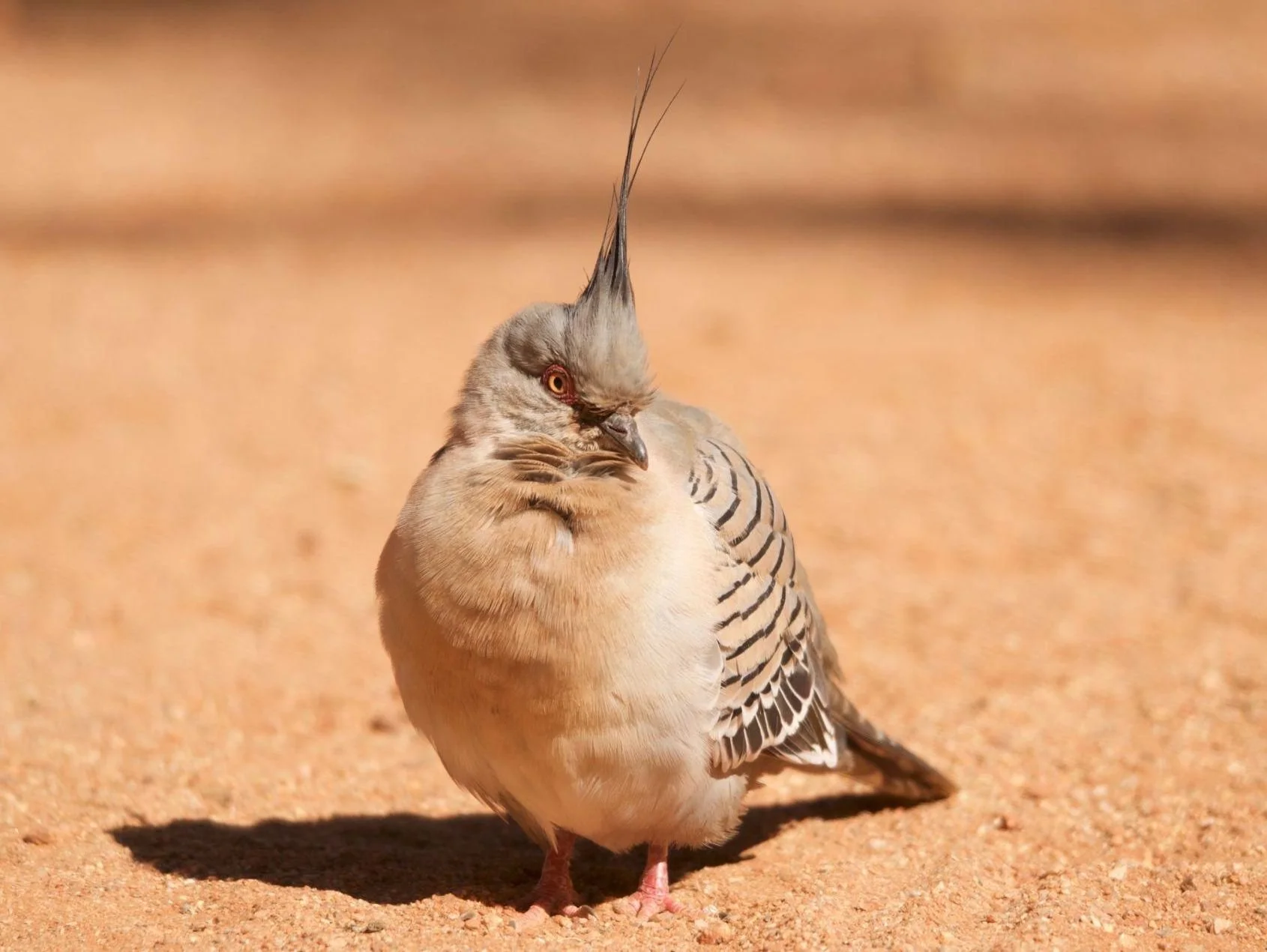
by Nicholas Munday, Adelaide Urban Birding
The subject of this article is a native bird that is often mistakenly considered as an introduced species: the Crested Pigeon (Ocyphaps lophotes).
With its grey and pinkish plumage, shining bronze wings and distinctive head crest, sometimes (misleadingly) called a ‘top-knot’, the Crested Pigeon is a distinctive and elegant bird.
Unlike the familiar Rock Doves or ‘Feral Pigeons’ (Columba livia), an introduced species from Afro-Eurasia that has become a notorious urban pest the world over, the Crested Pigeon is a true Australian endemic.
Indeed, Australia has an extraordinary abundance and variety of native pigeons and doves found in every niche and habitat, some of them as colourful and extraordinary as any of Australia’s parrots and songbirds, despite the popular misconception that all pigeons are introduced pests.
Pigeons and doves form the family Columbidae. The distinction between pigeons and doves is generally one of nomenclature, and an inconsistent one at that, which has little to do with any underlying evolutionary relationships. In Australia, the birds typically called ‘doves’ tend to be diminutive, with larger species being called ‘pigeons’, although there are some notable outliers such as the massive Wompoo Fruit-Dove (Megaloprepia magnifica) of eastern Australia.
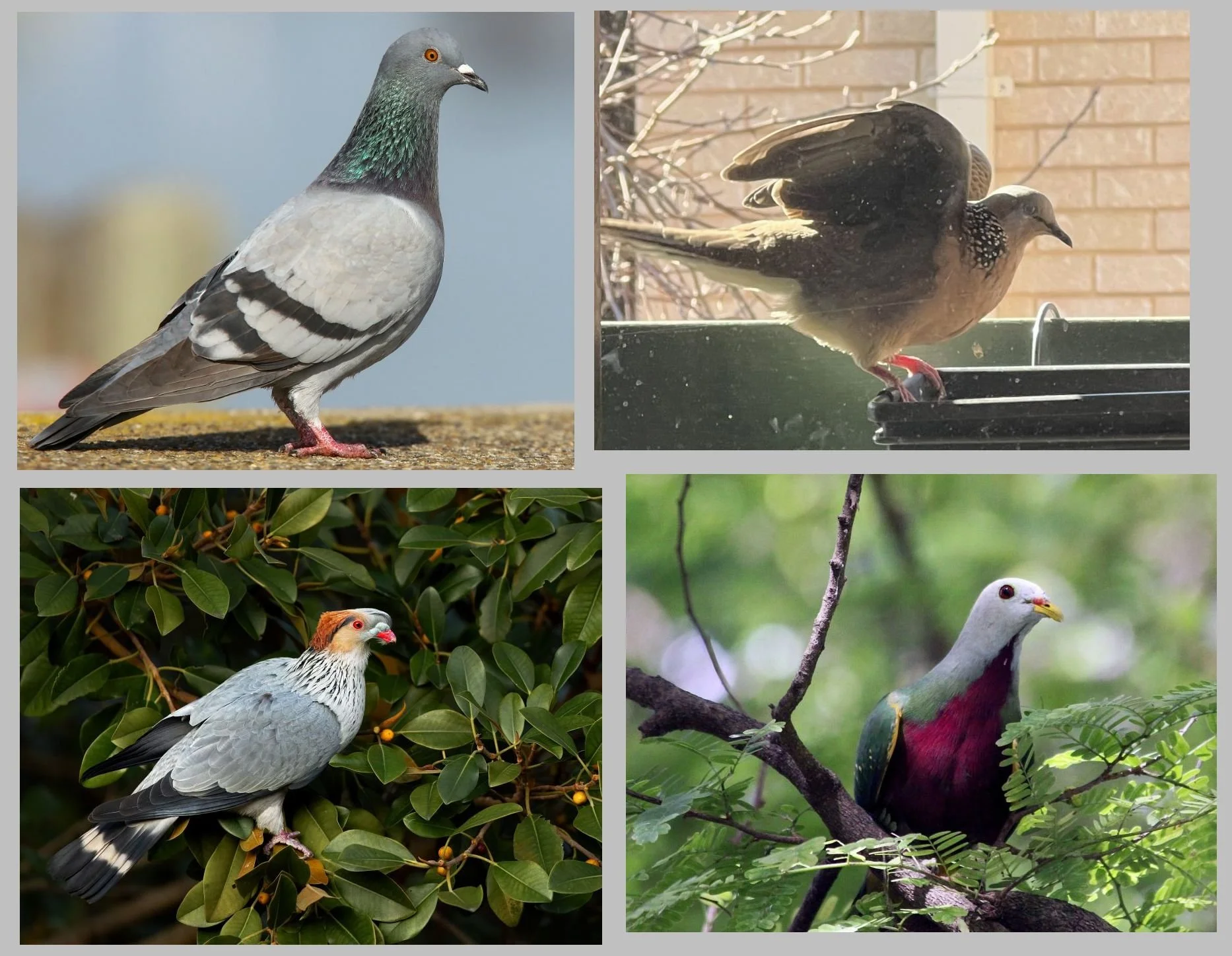
Other pigeon or dove species: not to be confused with the Crested Pigeon. Clockwise from top left:
* the common ‘rock pigeon’ or feral pigeon (Columba livia). Pic: Luke Seitz https://ebird.org/species/rocpig
* Spotted Dove (Spilopelia chinensis) Pic: Shane Sody
* Wompoo Fruit-Dove (Megaloprepia magnifica). Pic: cuartrok77
* Topknot pigeon (Lopholaimus antarcticus)
The Crested Pigeon is a further victim of inconsistent nomenclature. It goes by several common names, one of which it shares with a much larger bird from eastern Australia, the enormous Topknot Pigeon (Lopholaimus antarcticus).
Unlike the aridity-loving Crested Pigeon, the Topknot Pigeon is a rainforest specialist, and highly unlikely to be found anywhere near your Adelaide Park Lands (although it is occasionally reported as occurring there, in error, by people intending to record sightings of Crested Pigeons).
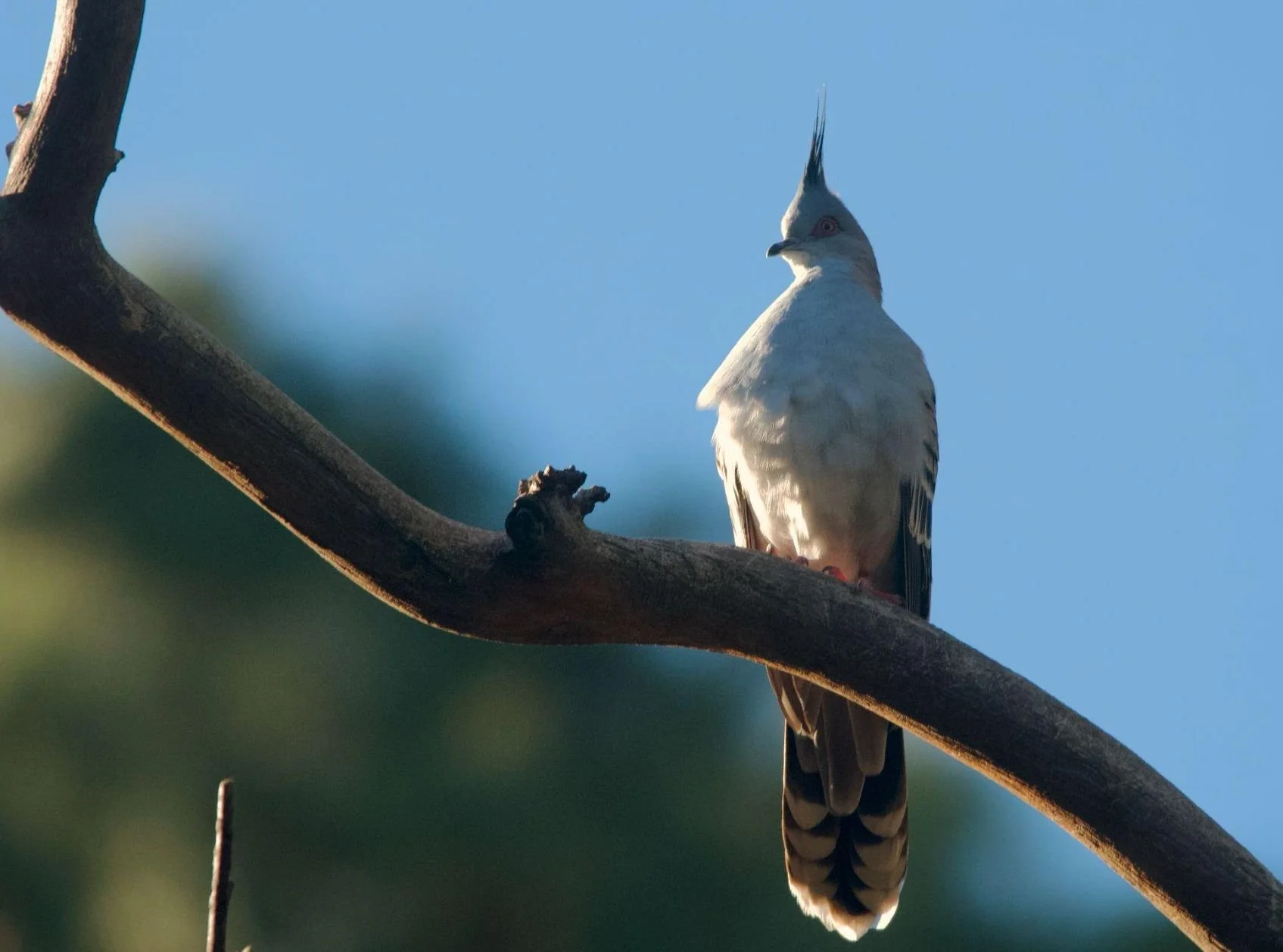
The Crested Pigeon cuts a distinctive silhouette, seen here in Botanic Park (Park 11). Photograph: Adelaide Urban Birding.
Crested Pigeons were historically exclusively found in the drier inland parts of the country, adapted for a partly nomadic lifestyle. However, the large-scale removal of woodlands and forests for pastures and cropping, combined with successive droughts, have seen the Crested Pigeon take over the vast majority of the Australian continent. These birds can now be found in every mainland city, and are among the most commonly encountered native birds within your Adelaide Park Lands.
Usually found in small flocks, Crested Pigeons tend to stay close to the ground foraging for seeds, although they will occasionally include leaves and insects as part of their diet as well. When startled, the birds will take flight rapidly, emitting a distinctive ‘whistle’ as they do so. This whistle is not a vocalisation; instead, it is produced by a single feather on each wing, and acts as an immediate built-in alarm, which many other birds are attuned to as well. Crested pigeons are effectively the self-appointed sentries within their environment.
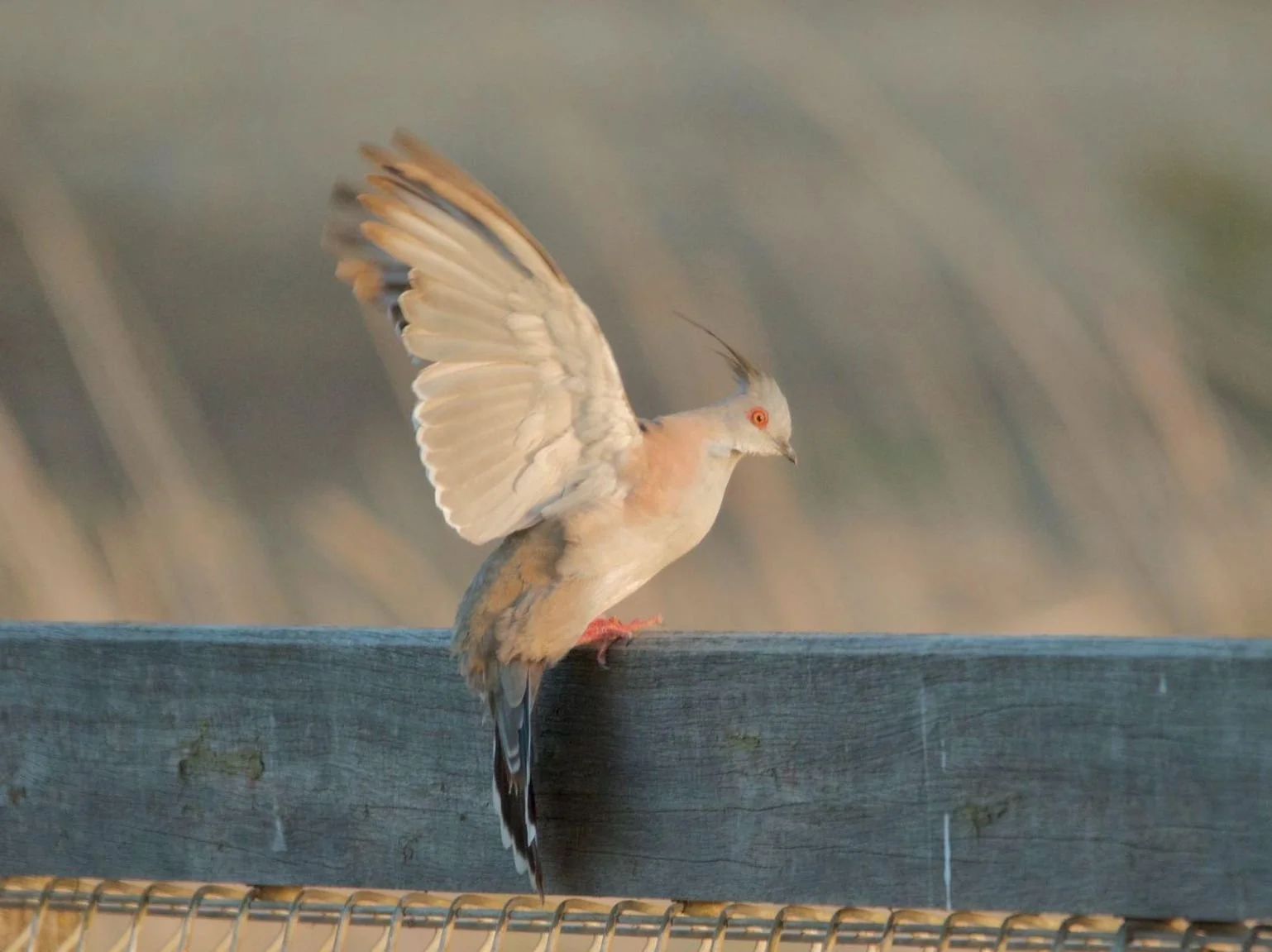
By rapidly fluttering its wings, the Crested Pigeon produces an alarm for all other birds in its environment. Photograph: Adelaide Urban Birding.
Spring and summer is when the birds are at their most prominent, being the time of year when the males are particularly motivated to woo as many females as possible. The way they attempt to do this is as unmistakable as it is comical; the males fluffing out their chests, fanning their tails and wings, and coo-ing and head-bobbing relentlessly to gain female attention. Whilst this sometimes results in successful copulation, most males are met with indifference. Still, practise makes perfect, and these performances are certainly engaging for passing humans.
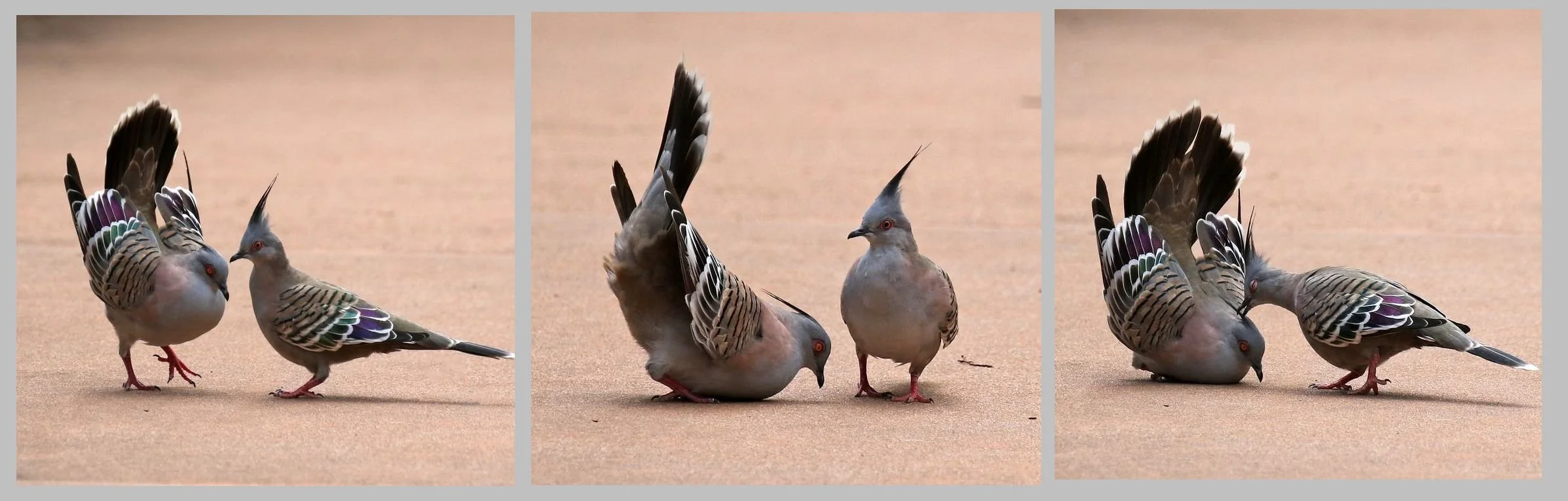
Pics: @anudibranchmom / iNaturalist. Creative Commons licence
Crested Pigeons can be seen across virtually all of your Adelaide Park Lands, although reliable places to find them include Bonython Park / Tulya Wardli (Park 27), Victoria Park / Pakapakanthi (Park 16), Possum Park / Pirltawardli (Park 1), and Lefevre Park / Nantu Wama (Park 6).
To find out about other birds in your Adelaide Park Lands, check out our What Bird is That? series.
Top (banner) photo: Crested Pigeon by Adelaide Urban Birding.
Nicholas Munday is an environment and planning lawyer with degrees in law and science (evolutionary biology and ecology) from the University of Adelaide.
He has a strong interest in biodiversity conservation and runs the ‘Adelaide Urban Birding’ Instagram account (@adelaideurbanbirding), dedicated to his photography of native birds in the Adelaide metropolitan area.
In his free time, Nicholas is well-known in the Adelaide choral music and theatre communities and also enjoys bushwalking, writing, and, of course, photography.
The opinions expressed in this article are entirely those of the author. This author is not affiliated with the Adelaide Park Lands Association Inc.


