
A guide to some of the oldest, iconic trees of your Park Lands, by Emma Moss
Your Adelaide Park Lands are more than lawns and ovals. Scattered among the winding paths and park benches are living monuments — trees that carry stories of settlement, commemoration, climate resilience, and deep cultural significance.
From towering Moreton Bay figs to stately English oaks, these giants have witnessed Adelaide’s growth and continue to shape the urban forest we enjoy today.
Here are just a few of these living legends in your Park Lands.
Memorial Oak
This mighty English oak (Quercus robur) has stood in Creswell Gardens /Tarntanya Wama (Park 26) since 1914, honouring soldiers who fell in battle in the first few months of the First World War.
It’s stood through droughts and city redevelopment, now sitting close to Adelaide Oval — a testament to the city’s efforts to preserve heritage in the face of change.
This Oak is more than 14 metres tall, and its canopy stretches more than 27 metres east to west. The War Memorial oak tree is listed on the State Heritage register.
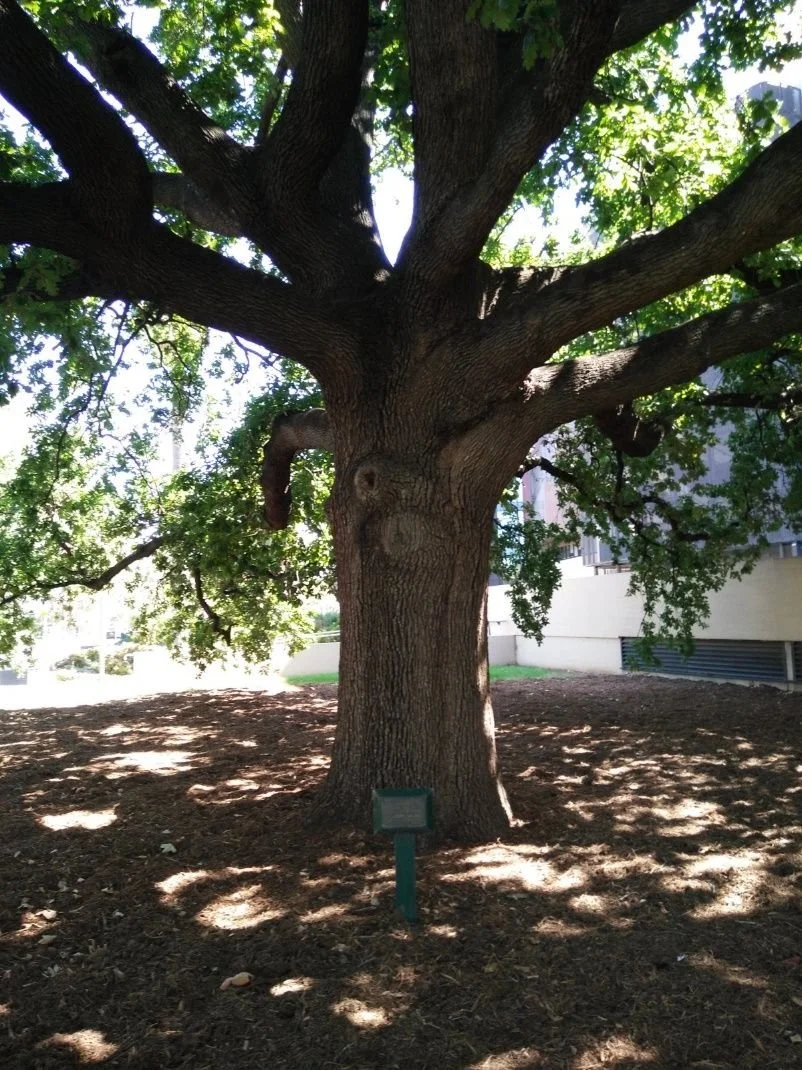
WW1 War Memorial Oak tree in Creswell Gardens, Wikimedia user “pdf.pdf” (2017). Creative Commons licence.
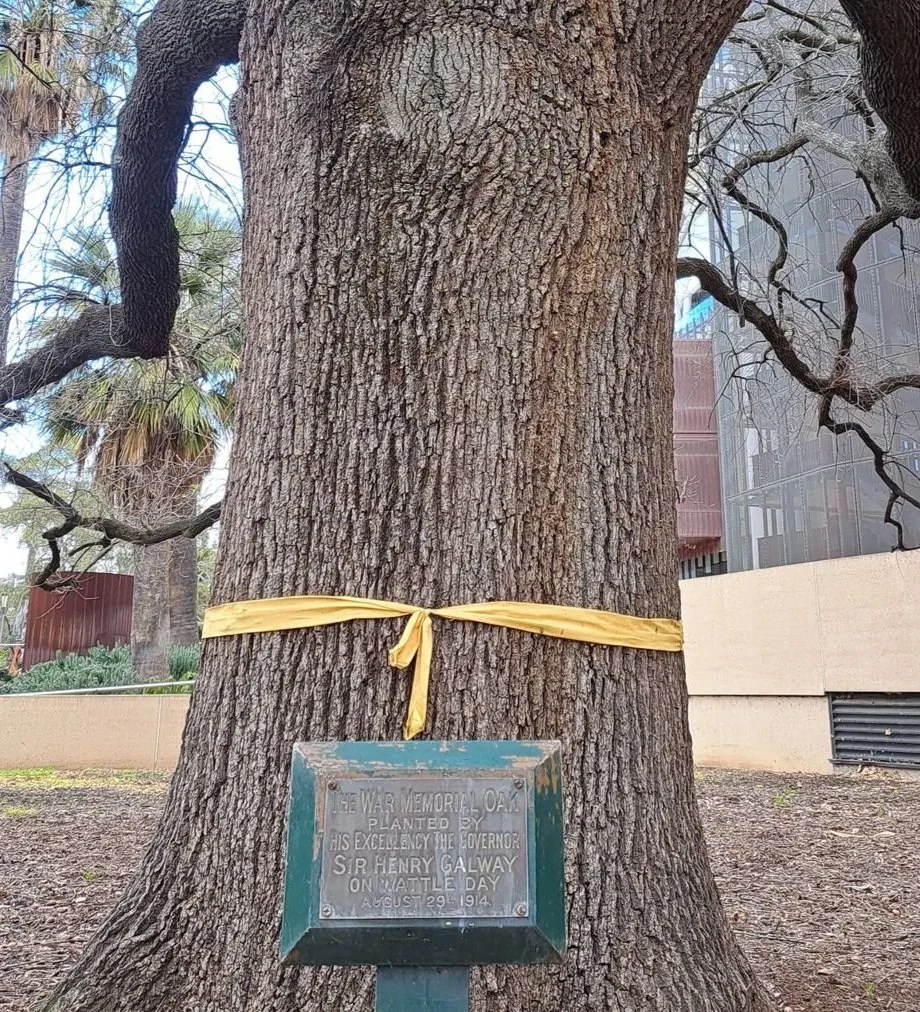
Pic: Shane Sody. Creative Commons licence.
Moreton Bay Figs
There are dozens of Moreton Bay fig trees (Ficus macrophylla) planted throughout your Adelaide Park Lands.
This well-known avenue of Moreton Bay fig trees in the Adelaide Botanic Garden was planted in the 1860s.

Other huge examples line sections of Plane Tree Drive around Botanic Park.
Still more Moreton Bay fig trees were planted in the 1880s to form a “carriageway” through Possum Park / Pirltawardli (Park 1), in what is now part of the North Adelaide Golf courses.
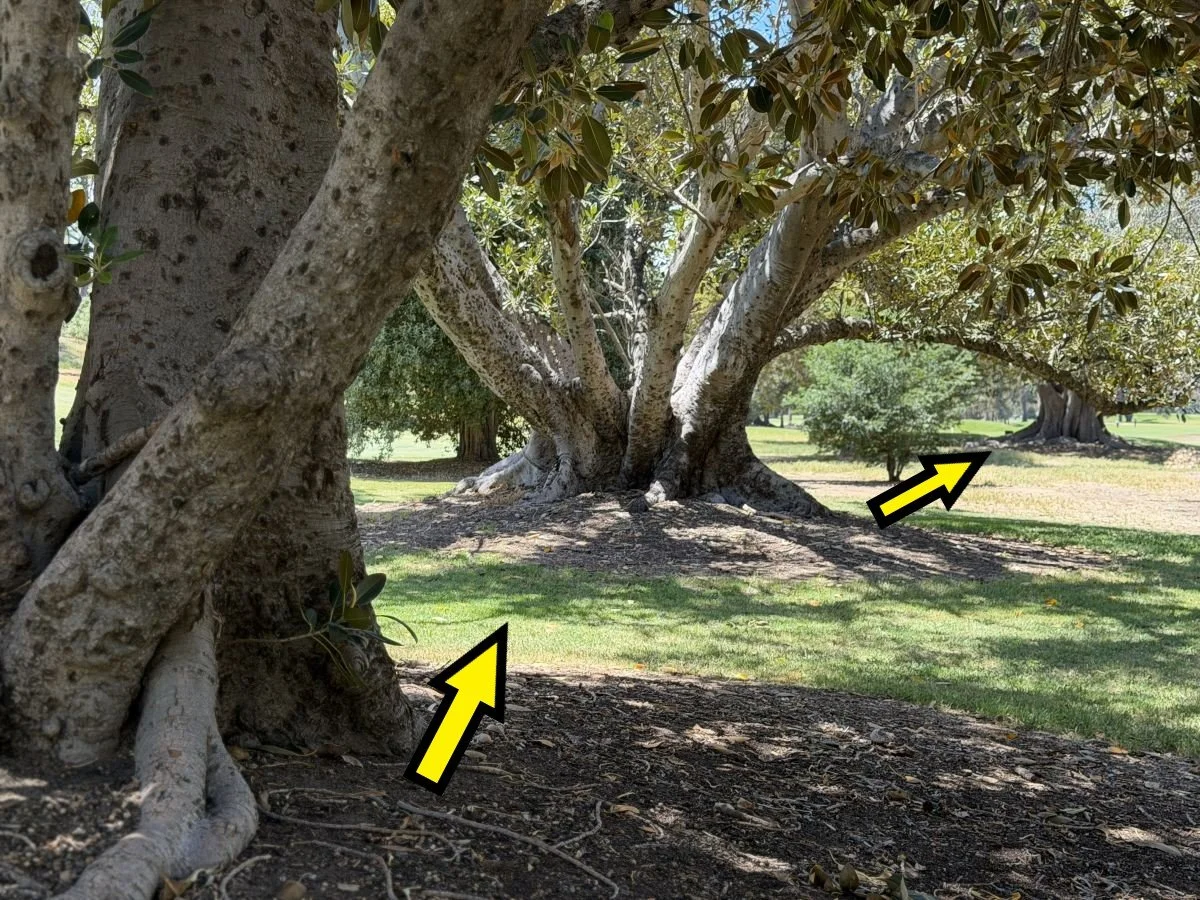
Remnants of an 1880’s “carriageway” of Moreton Bay fig trees between golf fairways in Possum Park / Pirltawardli (Park 1)
But perhaps the most spectacular (and certainly amongst the widest) is this one, believed to have been planted in 1875, in Red Gum Park / Karrawirra (Park 12), near the corner of Sir Edwin Smith Avenue and War Memorial Drive.
It captivates with its sprawling buttress roots and lush canopy.
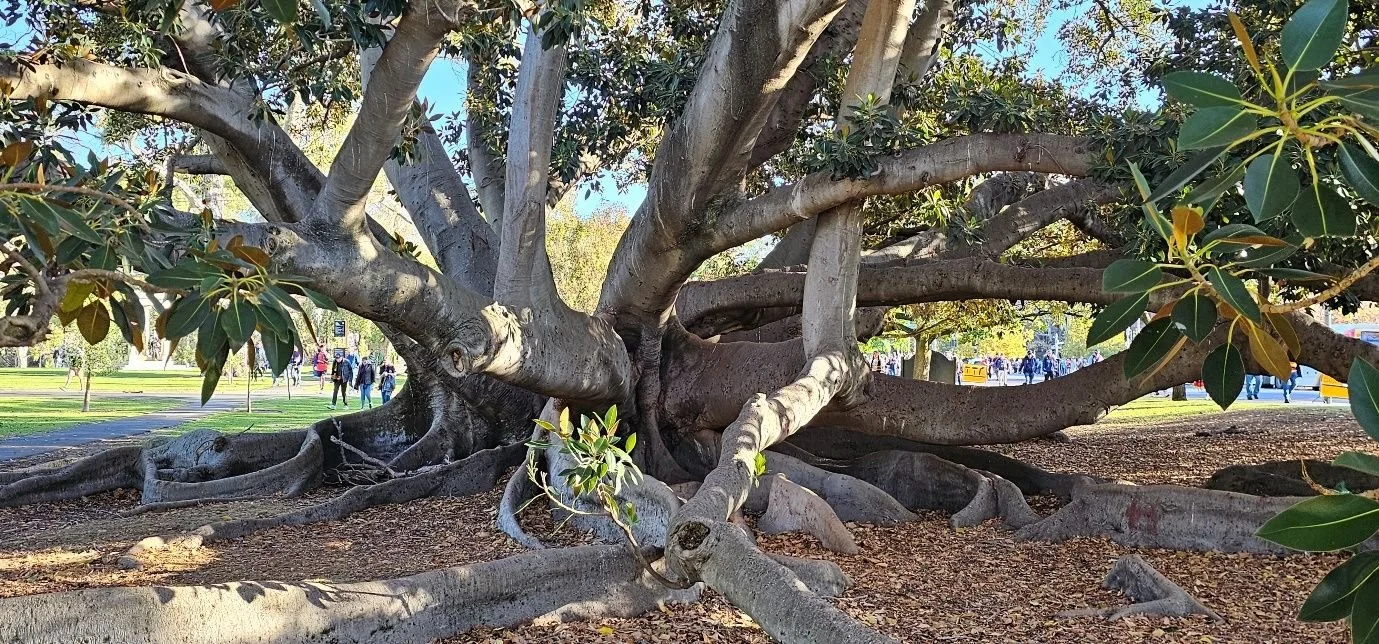
Moreton Bay fig trees are native to Queensland. They are supposed to thrive in sub-tropical locations, but many have thrived in Adelaide's climate conditions. They are well loved, serving shade and spectacle in equal measure.
Many of the historic trees in your Park Lands — like the Moreton Bay figs — were introduced by early European horticulturalists seeking to bring an English green aesthetic to Adelaide. Their longevity challenges expectations: species thought suited to temperate climates thrive here despite summer heat and drought, offering lessons in adaptation and ecological blending.
Palmer Gardens Sugar Gum
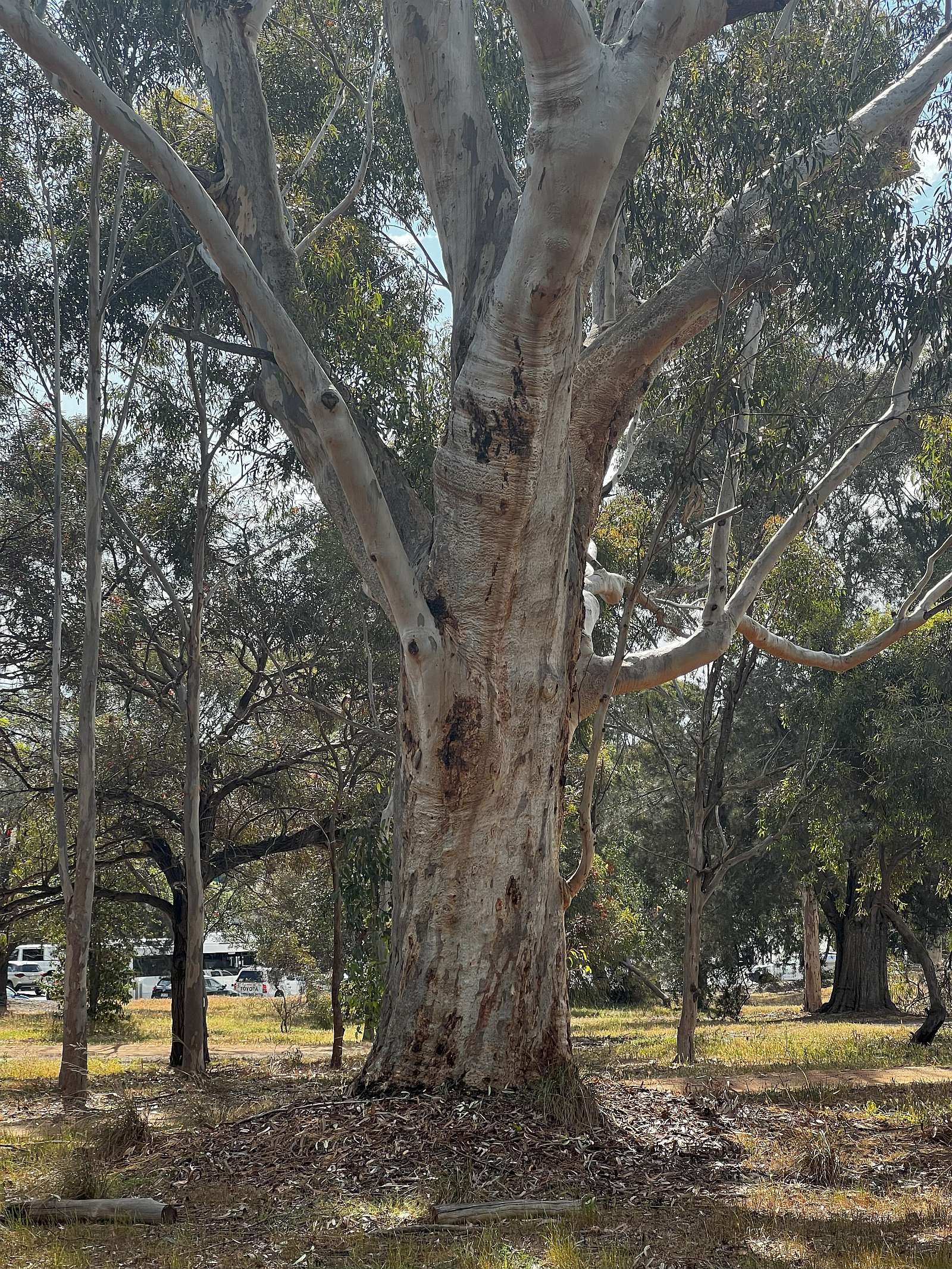
A native Eucalyptus cladocalyx, likely planted in the late 19th century, towers over Palmer Gardens Pangki Pangki (Park 28) with an imposing presence.
Its size reflects both the resilience of local species and their cultural value as symbols of place.
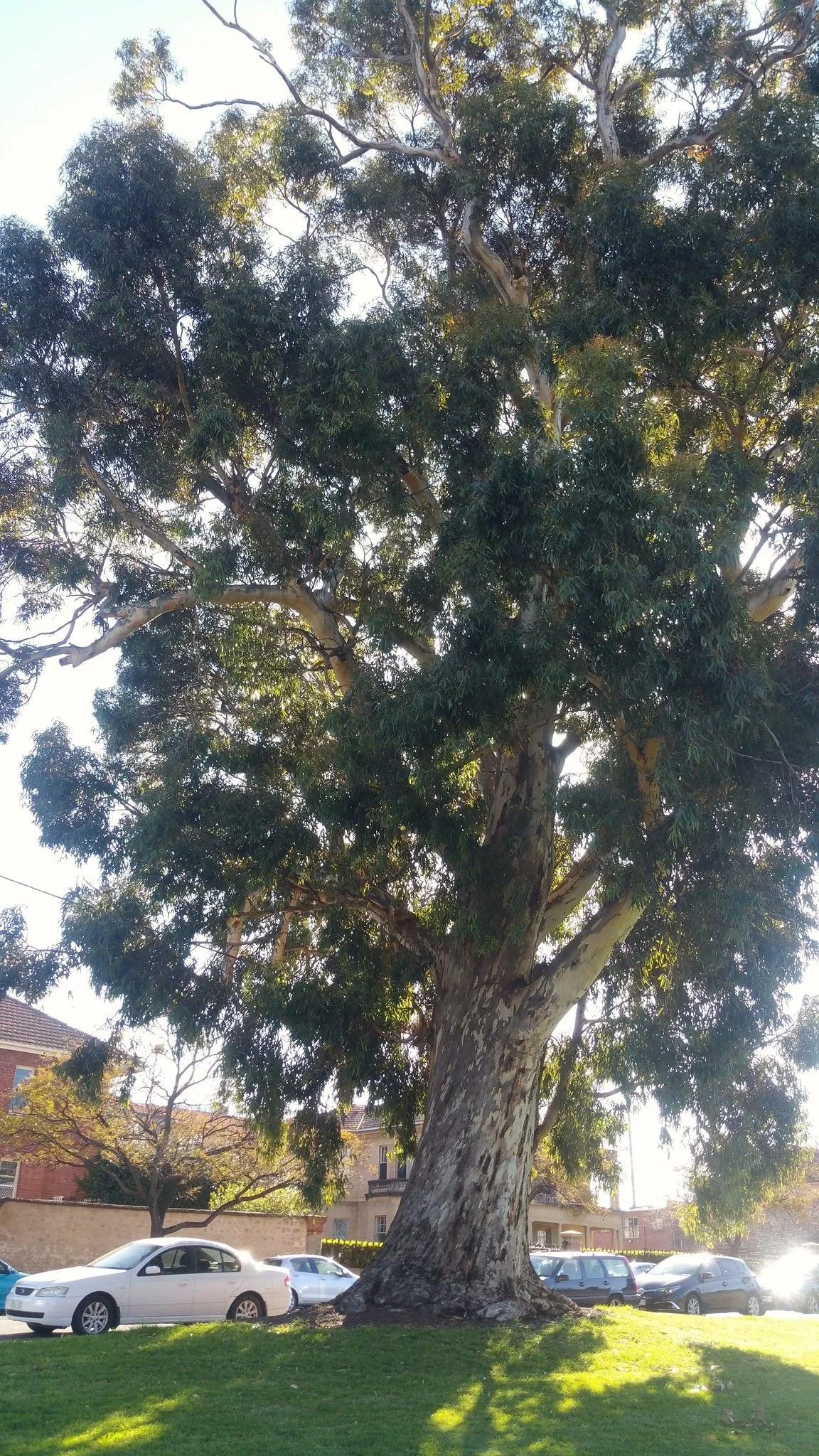
Possibly as old as the 1870s; a Sugar Gum (Eucalyptus cladocalyx) in Palmer Gardens/ Pangki Pangki (Park 28).
River Red Gums along Fullarton Road
Stretching in a remarkably straight line on the south-eastern side of Victoria Park / Pakapakanthi (Park 16), these towering River Red Gums (Eucalyptus camaldulensis) are about a century old, planted in the 1920s or earlier and stand as heritage markers in their own right — reminders of the pre-settlement landscapes that once defined this region.

Running along the south-eastern side of Victoria Park/Pakapakanthi (Park 16), adjacent to Fullarton Road, is this impressive line of thirty or more River Red Gum trees, along with many old olive trees.
Lone Pine (National War Memorial, Park 12)
This Aleppo pine (Pinus halepensis) stands as a tribute to the ANZACS of World War I.
Purportedly grown as a descendant of the original “Lone Pine” at Gallipoli, and planted on Remembrance Day, 11th November 1991, it reminds us of the courage and sacrifice of the ANZACS who served in the Battle of Lone Pine from World War 1 and invites reflection amid the hum of city life. The plaque inscription includes the phrase “Their name liveth for evermore.”
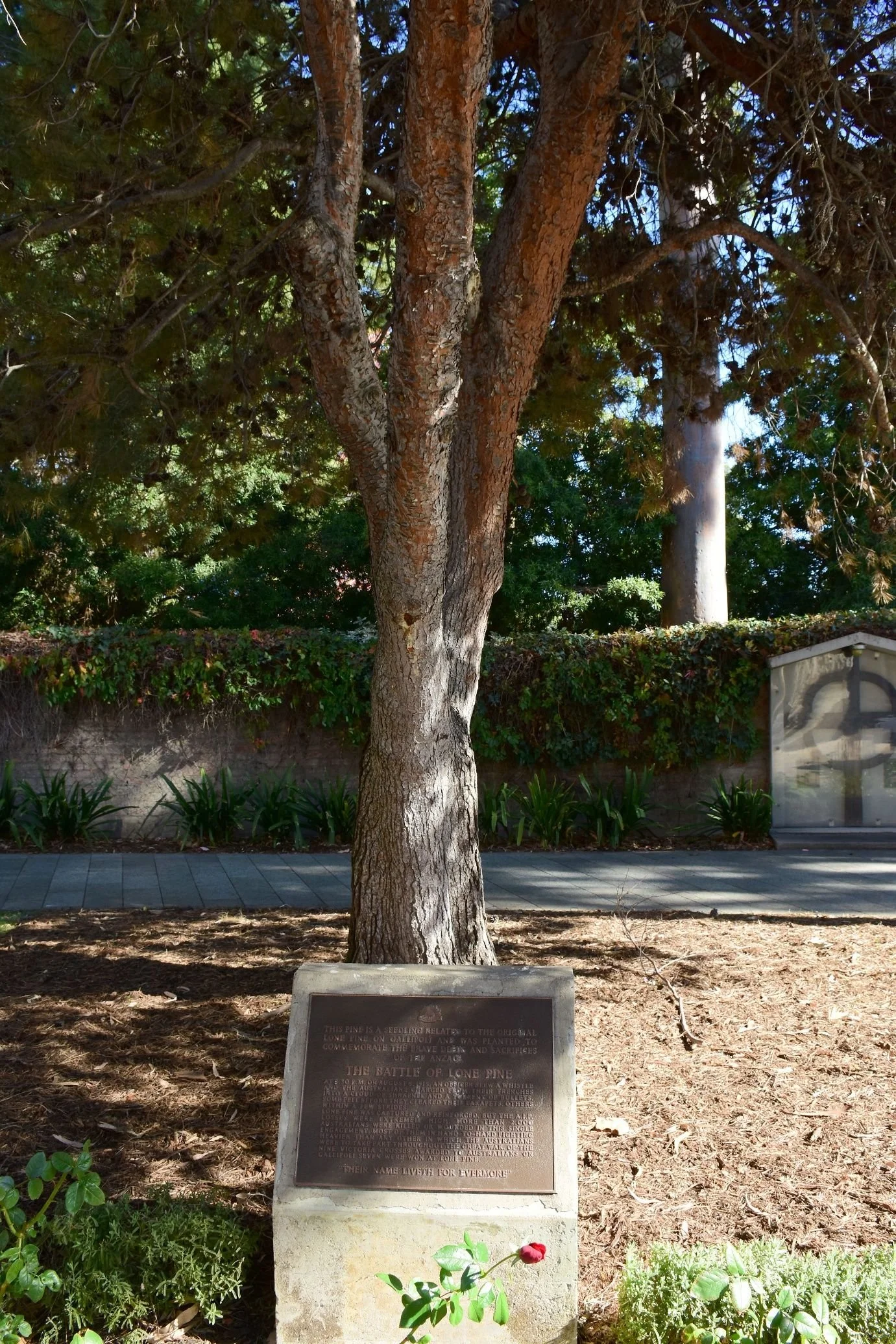
The Lone Pine tree at the National War Memorial. Pic: Henry Moulds Places of Pride (Creative Commons licence).
Deep roots of history and culture
While the trees profiled here can be regarded as “iconic” or “living legends” they are not the only trees contributing to the broad historical and cultural layers that enrich your Adelaide Park Lands.
Long before European settlement, the Kaurna people cared for the woodlands and grassy plains that now make up your Park Lands. River red gums — used for tools and shelter — and other native species formed part of seasonal cycles, resource gathering, and sacred learning. Acknowledging this deep history gives new meaning to the living trees we see today.
Urban forest tree map
The City of Adelaide has made available an Urban Forest interactive map, a live, searchable database tracking tens of thousands of trees by species, size, and location across Your Park Lands and city streets.

You can use the interactive map to:
explore by location. Zoom into any area of your Park Lands and click on an individual tree to learn its species, size, and sometimes age.
track species. Find out how many trees of a particular species are in your Park Lands, and where they are located.
report an issue. If you notice damage, signs of ill health, or even a missing tree, the map includes options to report these concerns directly to the City of Adelaide arboriculture team.
share the love. You’re invited to write a “love letter” to one or more of your favourite trees.
The interactive tree map is still a work in progress, with ongoing updates and some gaps in coverage — particularly where State Government agencies manage parts of your Park Lands.

Visiting With Purpose
Next time you stroll through any part of your Park Lands, try pausing directly underneath one of the larger trees, look up into its canopy, and imagine the world as it was when it was planted.
These trees are not just botanical specimens — they are living legends; anchors of memory, climate resilience, and community identity for Adelaide.
The author of this article, Emma Moss, is a volunteer writer for the Adelaide Park Lands Association.
With a professional background in Learning and Development, Emma is passionate about education, clear communication and community engagement.
Outside of work, she is a dedicated artist and an advocate for animal and wildlife conservation.


